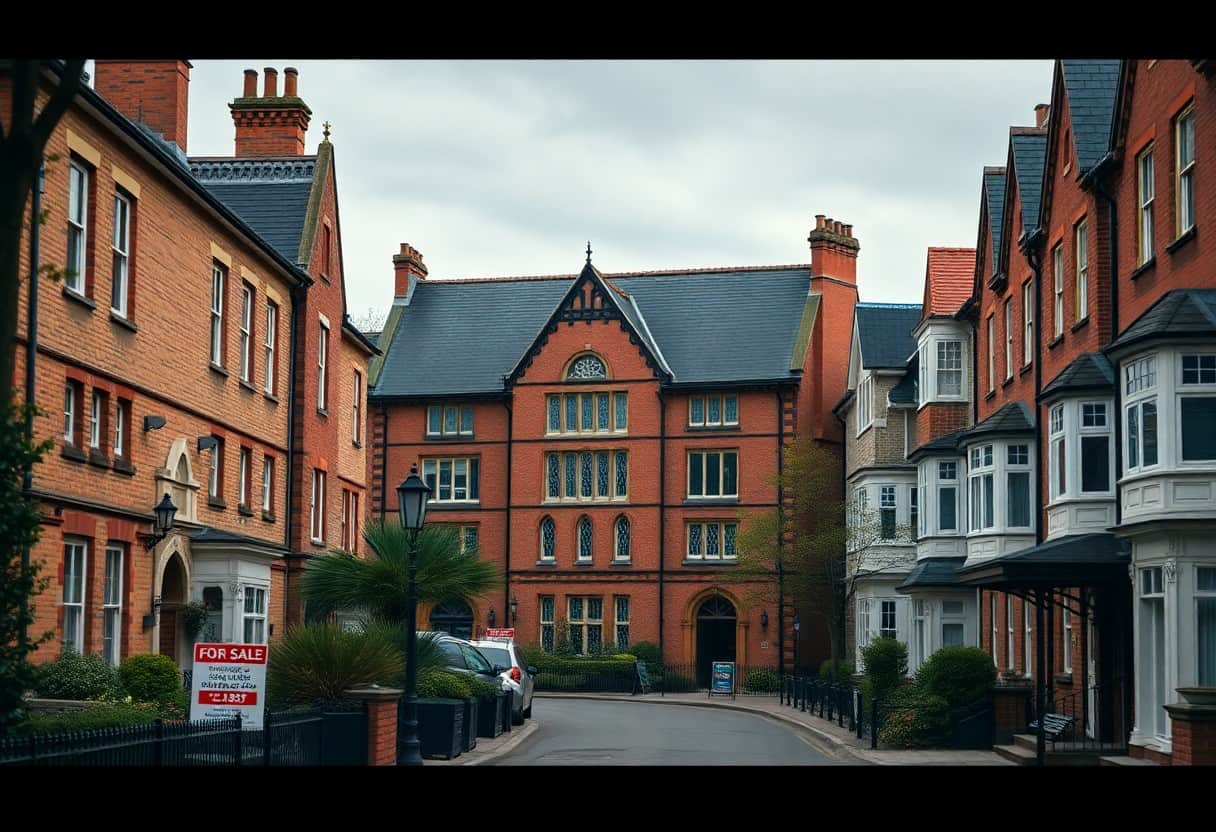
There is no official league table of the "best" schools in Cambridge, but the public data points to a clear group of strong performers. Several state secondary schools in and around the city were judged outstanding in every area at their most recent Ofsted inspection, and most had GCSE results above the England average in 2024/25. Hills Road Sixth Form College and the Cambridge Maths School post A level results well above the national average, and the city has independent schools such as The Perse and The Leys.
Do good schools push up house prices? Research using house sales across England has found a measurable premium near better-performing primary schools, of around 3% for a substantial difference in school quality. We have not found a reliable, published figure for a school catchment premium in Cambridge itself, so treat any precise local percentage you see with caution. What is certain is that living in a catchment does not guarantee a place, and that catchments can change.
Ofsted has changed how it reports. From September 2024 it stopped giving state-funded schools a single overall grade, so graded inspections between then and November 2025 judged each key area separately, and ungraded inspections gave no grades. Inspections since 10 November 2025 produce report cards, which grade each area on a five-point scale: exceptional, strong standard, expected standard, needs attention and urgent improvement, with safeguarding marked as met or not met. Ofsted says the new grades cannot be compared with the old ones.
Ofsted normally inspects a school every four years, so most of the schools in this article have not yet had a report card. Their latest report still uses the old words (outstanding, good, requires improvement, inadequate), and those describe the school on the date of that inspection. Always check the date.
For exam results, use the Department for Education's Compare school and college performance service, which the DfE says is being replaced by a new service from autumn 2026. Progress 8 scores were not calculated for 2024/25 because there is no key stage 2 baseline for that year group, so the most useful GCSE measure is the percentage of pupils achieving grade 5 or above in English and maths. In 2024/25 that was 49.6% across Cambridgeshire and 45.4% across all state schools in England.
The lists below cover the main state secondary schools, sixth forms, independent schools and special schools in and around the city, with their age range, type, latest Ofsted inspection and, for state secondaries, the 2024/25 grade 5 or above in English and maths figure. Information was checked on 13 October 2026. The state secondary lists are in order of that GCSE figure, which is one measure among several, not an overall ranking. The best school for one child is not always the best for another, so use this as a starting point, then read the reports and visit.
Cambridge and the surrounding villages have too many primary schools to rank fairly here. For each one, look at the latest Ofsted report and its date, and at the percentage of pupils meeting the expected standard in reading, writing and maths at key stage 2 on the DfE service. Cambridgeshire County Council also publishes how places were allocated at each primary school in previous years, including which were oversubscribed. A few primaries do not use a catchment area for admissions, including Chesterton Primary School and St Alban's and St Laurence Catholic primary schools in Cambridge.
Outside the city, many secondary schools are village colleges. If you are weighing up locations, our guide to the best Cambridge villages for families and our area guides for villages such as Histon and Comberton cover local amenities in more detail.
Sixth form colleges were inspected under the further education framework, which still gave an overall grade until report cards arrived. A level figures are the DfE's average A level grade for 2024/25, against an England average of B minus.
Apply to independent schools directly, and check each school's website for entry points, assessments and fees. Since 1 January 2025, VAT at 20% has applied to private school fees, including boarding fees.
If your child has an EHC plan, the application goes through their SEN casework officer rather than the normal process, and a school named in the plan must give your child a place.
Cambridgeshire County Council coordinates applications for all maintained schools and academies in the county. You apply to your home council even if you want a school in another area, and you can name up to three preferences. For September 2027 entry, secondary applications close on 31 October 2026, with offers on 1 March 2027. Primary applications close on 15 January 2027, with offers on 16 April 2027. Sixth form places, and independent schools, are applied for directly.
Each school has an "admission authority" that sets its oversubscription criteria. For community and voluntary controlled schools it is usually the council. For academies and free schools it is the academy trust, and for foundation and voluntary aided schools it is the governing body. That is why criteria differ from school to school: some church schools admit from a wider area on religious grounds, and some schools use extended catchments.
Most Cambridgeshire schools give priority to children living in a defined catchment area, and the council has an interactive map. Two points matter for buyers. First, living in a catchment does not guarantee a place if the school is oversubscribed. Second, catchments are part of each school's admission arrangements, which must be set every year. A change has to go through public consultation first, so a catchment that covers a street today may not cover it in future. Check the arrangements for the year your child will apply.
The council allocates places from your child's main residence. A future move only counts if it is confirmed and you can prove it, for example with a solicitor's letter confirming exchange of contracts or a signed tenancy agreement. The council's 2027 to 2028 booklets say a tenancy should be for at least six months and signed by both tenant and landlord (its online FAQ says six school weeks, so check with the admissions team), and proof must be in the applicant's name and dated within three months of the application. For secondary places, the address must be your child's permanent home when places are offered on 1 March 2027 and when they start in September 2027. For September 2027 secondary places, proof must reach the council before 1 December 2026 (before 24 November 2026 if you have named a school outside Cambridgeshire); for primary places, before 31 January 2027. If it arrives late, the application may not be considered from the new address until the second round. Misleading applications can lead to a place being withdrawn. If you are buying with a school place in mind, plan your exchange date around these deadlines, and read our guide to buying a home for school catchment.
The clearest UK evidence we found is a study by Stephen Gibbons, Stephen Machin and Olmo Silva, published by the Centre for the Economics of Education at the London School of Economics (discussion paper 132, 2012). Using HM Land Registry sales across England from 2000 to 2006, they compared similar homes on either side of admission authority boundaries near primary schools. They found that a one standard deviation improvement in a school's value-added or in its pupils' prior achievement raised prices by around 3%. That is a national average from data now 20 to 26 years old, not a Cambridge figure.
Official price data is not published by school catchment. HM Land Registry's UK House Price Index puts the average price in Cambridge at £475,151 in July 2026, against £293,479 for England, with Cambridge prices flat (0.0%) over the year. School catchment is one of many factors behind those numbers, alongside commuting, housing type and the local jobs market, and we cannot isolate its effect reliably. For a wider view of the market, see what's really happening to Cambridge prices. If you are selling near a popular school, a valuation based on recent local sales will tell you more than any rule of thumb.
Grades move. Trumpington Community College was judged requires improvement in 2019 and good in 2023, while Bottisham Village College went from outstanding in 2012 to requires improvement in 2024. As schools receive report cards over the next few years, their reports will look different, and the new grades are not a like-for-like replacement for the old ones.
Several schools around Cambridge are relatively new, including Cambourne Village College (opened 2013), Trumpington Community College (2015), Trumpington Park Primary School (2017) and the Cambridge Maths School (2023). When new schools open, admission arrangements, including catchments, may be revised, which is another reason to check the current arrangements before you buy.
This article is general information, not advice on any individual application. Check the current admission arrangements with Cambridgeshire County Council and the school before you buy or rent.
On the latest public data, Chesterton Community College, Parkside Community College and St Bede's Inter-Church School stand out in the city, with outstanding judgements at their latest Ofsted inspections (for Parkside, an ungraded 2023 inspection confirming its 2017 grade) and 74% to 84% of pupils achieving grade 5 or above in English and maths in 2024/25. Impington, Comberton, Cambourne and Swavesey village colleges were also judged outstanding in every area at their latest inspections.
No. Cambridgeshire County Council says living in a catchment does not guarantee a place if the school is oversubscribed, and catchments can change because admission arrangements are set every year.
A national LSE study found prices rose by around 3% for a one standard deviation improvement in primary school quality. There is no reliable published figure for Cambridge.
Not in new inspections. Ofsted dropped the overall grade for state schools in September 2024, and since November 2025 its report cards use exceptional, strong standard, expected standard, needs attention and urgent improvement. Older reports keep their original grades.
Secondary applications close on 31 October 2026 and primary applications on 15 January 2027. Apply through Cambridgeshire County Council if you live in the county.
Only if the move is confirmed and you can prove it, for example with a solicitor's letter confirming exchange of contracts, sent before the council's deadline.